Articles

The amount of talk surrounding online gambling has increased dramatically since the Department of Justice clarified the Wire Act just over one year ago. Most of the attention, however, has been focused on legislation to allow players to access gaming services from their homes over the Internet. While this has resulted in much noise but little action, interactive gambling on licensed premises via mobile devices is now legal across some of the U.S.’ biggest gaming markets.

I write today to reflect on the significant change that this nation and Indian country are facing with the loss of two great statesmen, the Honorable Sen. Daniel K. Inouye (D-Hawaii) who was called home on Dec. 17, 2012, and the Honorable Rep. Dale Kildee (D-Mich.) who retired from Congress at the end of last year. I also write to suggest a path forward together.

Some of the most misunderstood concepts related to tribal gaming and its resulting economic development are those regarding Indian preference in hiring employees and vendors. Understanding this subject is crucial to working within Indian country for both tribal entities and vendors seeking tribal business relationships. The indigenous peoples of the United States today own American Indian tribal companies, all of which are structured and directed to address economic conditions among some of the poorest people.

This is the inaugural edition of the monthly Union Gaming Analytics (UGA) index of gaming operators. Since this is the first edition, we will describe the methodology we used in compiling it. For reference, the index is compiled of 23 global gaming operators ranging in market cap from $33.4 billion (Las Vegas Sands) to $221 million (Isle of Capri). To take into account company size, we have comprised index weights based on market capitalization.

It’s February, and there is so much going on that truly excites me. This is a good month. For one, this issue of the magazine is getting around. Literally. It’s being distributed at four industry conferences—iGaming North America, Florida Gaming Congress, the American Bar Association’s Gaming Law Minefield and the World Game Protection Conference. It’s thrilling for me to see the reach CEM has and the new audience we’re gaining.

New gaming products for table games and gear include GPI, RFID Tray Inventory Module; Galaxy Gaming, High Card Flush; Genesis Interactive, Quick-Change Tabletops; Interblock, G4D Bubble with Pop'n Poker Game; and SHFL entertainment, Neverbust Blackjack.

The Department of Labor reported in November that leisure and hospitality employment continued to trend up, adding 23,000 jobs for the month. Throughout the past 12 months, the industry has added 305,000 jobs. This indicates that hospitality companies are mildly optimistic for the year ahead. If this trend continues, suppliers could anticipate an increase in gaming equipment investment from operators during the year ahead.

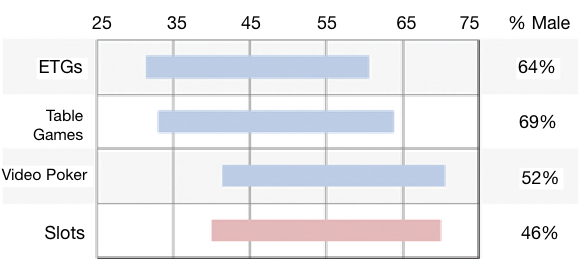
We’re following up our popular “Where’s the Money?” series and looking forward to the upcoming 18 months, during which we will tackle more tough analytical questions. This article examines changes in player demographics, in particular the games that different age groups like to play. One notable example of player preference is that younger players are playing heavily on electronic table games (ETGs).

The gaming industry won most of its battles at the ballot box this past November, but it lost the public relations war. In Maryland, voters passed Question 7, 52 percent to 48 percent. Oregon again voted against privately owned casinos, but that is mixed news, since it would have meant competition for the state’s Indian casinos.

After what seemed like a never-ending election season to many Americans, the results came in on Nov. 6, and are about to be implemented in the form of the newly installed 113th Congress. Thanks to the hard work of tribal leaders, community organizers and advocates, Native Americans made it to the polls in record numbers. Our voice was heard loud and clear, and we made a difference.