This article explores the relationship between being “lucky” and visitation frequency. Long held as being invariant, the theoretical win of a game is the statistical win of the players over the long term. From the perspective of the casino with large numbers of players, this number is incorrect.
Communism has wreaked havoc on Cuba’s economy, but can casinos repair it? With the Castro’s finally on their way out of office, the country might do well to consider re-opening its classic casinos.
With no federal Internet gaming bill on the horizon, it’s again to the states. Nevada was the first state to adopt regulations and develop a licensing procedure for Internet gaming, which is currently limited to poker. Other states are currently considering legislation authorizing Internet gaming. Any Indian nations with land in a state considering Internet gaming must be prepared.
The end of 2012 saw the United States on the precipice of higher tax rates springing back to life, the elimination of favorable business tax provisions and significant cuts to federal spending. From the edge of the proverbial fiscal cliff, the United States leaped to the closest ledge at the beginning of 2013, with the politicians finally reaching an agreement to mostly preserve current tax rates and extend numerous favorable business tax provisions.
Understanding the gambling experience can be likened to fishing, and this analogy may help explain some of the behavioral aspects of the gambling experience. In recreational fishing, the fisherman invests time (and money) in hopes of catching a fish. But on most fishing trips, the time and money invested in fishing is, at least in our experience, nothing akin to the return that is received. However, the moment of actually catching a fish makes it all worthwhile.
Licensed gaming is slowly becoming just another legal business, which is a very good thing. Many of the strangest restrictions in the laws of past arose from centuries of gambling being seen by society—or at least by opinion leaders and lawmakers—as an activity that was simply not respectable. Gambling debts were unenforceable, and courts would no more allow casinos to advertise than they would brothels.
The rush is on for a Nevada Internet gaming license (or interactive gaming, as it is referred to in Nevada). As of the end of 2012, there were eight companies that were licensed by the Nevada Gaming Commission (the Commission) to operate interactive gaming, with 10 more companies with applications in the process of investigation and review. At the same time, there were eight licensed manufacturers of interactive gaming systems with 14 applicants still pending...
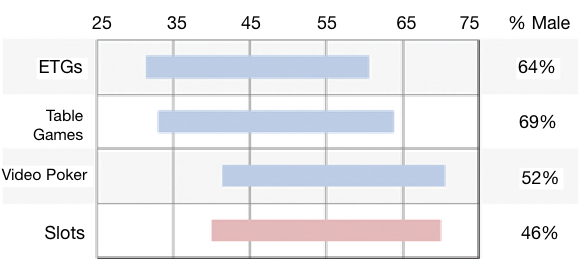
We’re following up our popular “Where’s the Money?” series and looking forward to the upcoming 18 months, during which we will tackle more tough analytical questions. This article examines changes in player demographics, in particular the games that different age groups like to play. One notable example of player preference is that younger players are playing heavily on electronic table games (ETGs).
The gaming industry won most of its battles at the ballot box this past November, but it lost the public relations war. In Maryland, voters passed Question 7, 52 percent to 48 percent. Oregon again voted against privately owned casinos, but that is mixed news, since it would have meant competition for the state’s Indian casinos.
On Dec. 3, 2012, the U.K. government published a long-awaited draft gambling (licensing and advertising) bill proposing changes to the basis upon which remote gambling is regulated in Britain. The bill covers less than one and a half pages, contains only four sections, and its proposals are for the amendment of only three sections of the 2005 Gambling Act.